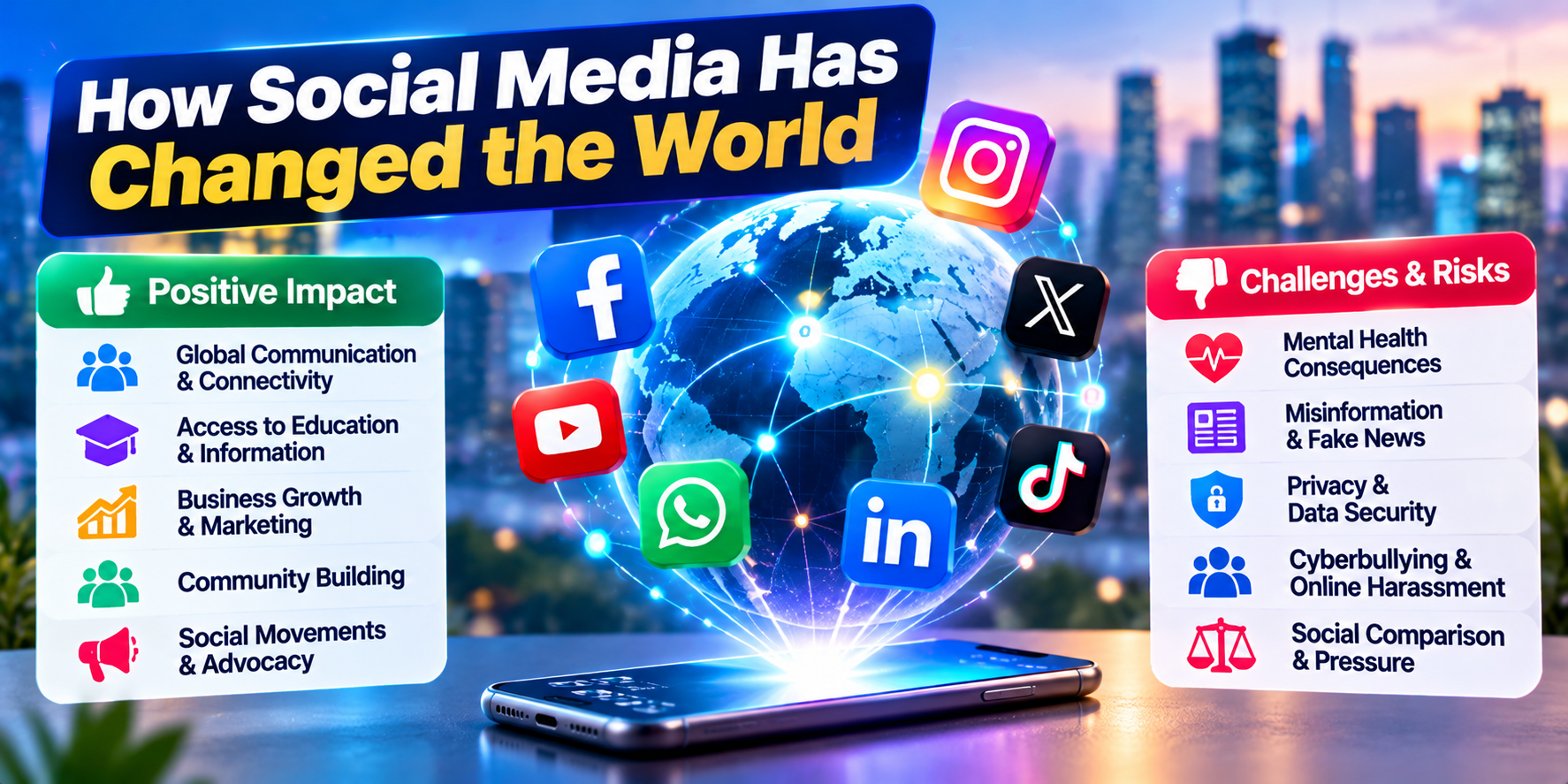
How Social Media Has Changed the World
More than 5 billion people now use social media platforms globally. That figure represents over half the world's population interacting, sharing information, building relationships, and consuming content through platforms that did not exist two decades ago. The speed at which social media embedded itself into daily life was unprecedented — and so, inevitably, were its consequences.
The impact of social media is neither uniformly positive nor uniformly negative. It has genuinely transformed how people communicate, learn, organise, and conduct business. It has also created measurable harm in the areas of mental health, information quality, and personal privacy. Understanding both sides clearly is more useful than reaching for a simple verdict.
Key statistic: Over the past year, approximately 256 million new users joined social media platforms, representing annual growth of 5.2% — an average of 8.1 new users per second. (Source: ClearVoice)
Positive Impact of Social Media
Global Communication and Connectivity
Social media eliminated the practical barriers to staying connected across distance. WhatsApp allows families separated by migration to maintain daily contact. LinkedIn sustains professional relationships across organisations and industries. X (formerly Twitter) gave ordinary people a mechanism to participate in public discourse during elections, crises, and major world events — a kind of civic participation that was previously limited to those with media access.
During natural disasters and public health crises, social platforms have served as critical information distribution networks, enabling coordination between affected communities and relief organisations faster than traditional broadcast media could manage.
Democratised Access to Education and Information
YouTube tutorials, Reddit threads, and educational creator content have made knowledge that once required expensive courses or institutional access available to anyone with internet access. A student in a rural area with limited educational infrastructure can learn programming, mathematics, or professional skills from the same resources as someone attending a well-funded university.
This democratisation is imperfect — it depends on digital literacy, language access, and reliable connectivity — but as a directional change, it represents a significant expansion of educational opportunity.
Business Growth and Marketing
Social platforms fundamentally changed the economics of marketing. A small business can now reach a precisely targeted audience on a modest budget through Facebook and Instagram advertising, achieving results that would have required significant media spend through traditional channels. Direct customer communication through social accounts gives businesses feedback loops that were previously limited to expensive market research.
For entrepreneurs and sole traders particularly, social media removed significant barriers to visibility. An independent craftsperson or consultant can build a substantial client base through consistent organic content — something that required agency support or significant capital just fifteen years ago.
Community Building
Online communities have created belonging for people who might otherwise remain isolated. Support groups for rare medical conditions, professional communities for niche specialisations, cultural communities for diaspora populations — these gather people who would be geographically dispersed and practically unreachable through any other mechanism. For individuals in marginalised communities or those with limited local social infrastructure, this connection carries genuine value.
Social Movements and Advocacy
Movements including #MeToo and #BlackLivesMatter used social platforms to organise, fundraise, and reach global audiences at a speed and scale that previous social movements could not access. Platforms gave individual voices the potential for broad reach — collapsing the distinction between official media and citizen reporting.
Negative Effects of Social Media
Mental Health Consequences
The relationship between social media use and mental health is complex, but the research direction is clear: passive, high-frequency social media consumption — particularly content involving social comparison — correlates with increased rates of anxiety, depression, and poor self-image, especially in younger users.
The mechanism is partly algorithmic. Platforms are designed to maximise time on site, and they do this by surfacing content that generates strong emotional responses. Curated highlight reels of other people's lives create comparison benchmarks that are essentially unachievable, because they represent the best moments of many people rather than the realistic experience of any individual.
Misinformation and Manipulation
False information spreads faster than accurate corrections on most social platforms. The Facebook-Cambridge Analytica case demonstrated the potential scale of the problem: data from approximately 87 million users was harvested without consent and used for political targeting. The episode illustrated how platform architecture, data infrastructure, and human psychology could be combined to influence behaviour at population scale.
Misinformation is not limited to political manipulation. Health misinformation, financial scams, and coordinated harassment campaigns have all used social platforms as distribution infrastructure.
Privacy and Data Security
A data breach on X in early 2023 compromised personal information from over 200 million accounts, including email addresses and usernames. This was one among many such incidents. Most social media users have limited understanding of the volume and sensitivity of the data their platforms collect, or the ways in which it may be monetised or exposed.
Platform privacy policies are extensive, rarely read, and typically structured to maximise data collection. Users who have not actively managed their account privacy settings are often sharing more than they intend.
Cyberbullying and Online Harassment
Online anonymity reduces the social inhibitions that constrain face-to-face interaction. The result is a significant volume of harassment, abuse, and targeted bullying that would not occur in person. Teenage users are particularly affected — cyberbullying follows victims across platforms and into their personal environments in a way that offline bullying does not, and the public nature of social media means embarrassment can be distributed widely and quickly.
Addictive Design and Compulsive Use
Notification systems, infinite scroll, likes, and engagement metrics are deliberate design choices intended to create habitual use. The dopamine feedback loops they generate are well understood by the engineers who built them. The practical consequences include disrupted sleep patterns, reduced productivity, and difficulty sustaining attention on tasks that do not provide the same instant reward signals.
The Impact of Social Media on Young People
Adolescents are disproportionately affected by social media's negative effects because their brains are still developing, particularly the regions governing impulse control and emotional regulation. Peer validation is also exceptionally salient during adolescence — making the social comparison dynamics of platforms particularly potent at this life stage.
Documented effects on young people include elevated rates of anxiety and depression, distorted body image from filter-heavy content, diminished attention spans associated with heavy short-form video consumption, and the intensification of FOMO (fear of missing out) and peer pressure.
This does not mean social media use is entirely harmful for young people. Intentional use — following accounts that inspire creative development, participating in communities around genuine interests, building skills through platform tools — can provide real value. The concern is with unstructured, high-volume passive consumption, and with platforms that prioritise engagement metrics over user wellbeing.
How Social Media Affects Business
For organisations, social media presents both opportunity and risk. On the opportunity side: direct customer communication, cost-efficient brand building, product research through listening tools, influencer partnerships, and customer service channels that many audiences now prefer to phone-based support.
On the risk side: public criticism scales instantly. A single negative customer experience, a poorly worded post, or an employee's personal social media activity can become a significant reputational incident within hours. Businesses that use social media without a clear strategy and crisis communication plan are exposed to risks they may not have fully anticipated.
Using Social Media More Intentionally
For individuals who want to manage their social media use rather than be managed by it, several practices are consistently supported by research:
- Use platform time-limit tools or third-party app timers to set daily boundaries
- Keep accounts on private settings and enable two-factor authentication
- Actively curate feeds by unfollowing or muting accounts that trigger negative comparison
- Avoid screens in the hour before sleep, as blue light and engagement patterns both impair sleep quality
- Distinguish between active and passive use — contributing, learning, or connecting is different from scrolling without purpose
- For young people, open family conversations about online experiences provide important context for processing what they encounter
Impact AreaPositive EffectsNegative EffectsCommunicationGlobal connection in real timeMisunderstanding and conflict at scaleInformation accessDemocratised education and newsMisinformation spreads faster than correctionsMental healthSupportive communities for isolated individualsAnxiety, depression, poor sleepBusinessCost-effective marketing and brand buildingReputation risk from public criticismYouthIdentity exploration and creative expressionCyberbullying and comparison pressurePrivacyTransparency and civic accountabilityData harvesting and security breaches
Frequently Asked Questions
What is the impact of social media on society?
Social media has transformed communication, reshaped news consumption, enabled global social movements, and created significant economic opportunity for businesses of all sizes. It has simultaneously contributed to the spread of misinformation, increased rates of anxiety and depression, and created new vectors for privacy risk. The net impact depends heavily on how individuals and organisations use these platforms.
How does social media affect mental health?
Research indicates that passive, high-frequency social media consumption — particularly involving social comparison — correlates with increased anxiety and depression. Active, intentional engagement in genuine communities tends toward neutral or positive effects. Teenagers and young adults experience the most pronounced impacts, partly because of developmental vulnerability and partly because of higher average usage rates.
What are the negative effects of social media on teenagers?
Documented negative effects include elevated anxiety and depression, sleep disruption, distorted self-image driven by filtered content, cyberbullying, and intensified peer pressure. These risks are not universal — usage patterns, platform choice, and the presence of parental guidance all affect outcomes.
Can social media be beneficial for business?
Yes — social platforms provide cost-effective access to targeted audiences, direct customer communication channels, and powerful brand building tools. Small businesses in particular benefit from the reduced marketing costs compared to traditional media. The benefits require a consistent strategy and awareness of the reputational risks that come with public visibility.
How does social media spread misinformation?
Platform algorithms optimise for engagement, and emotionally resonant content — including false or misleading information — often generates higher engagement than accurate but less dramatic reporting. This creates an environment where misinformation can reach large audiences rapidly, and where corrections and debunking typically receive less algorithmic promotion than the original false claim.
How many people use social media worldwide?
As of 2026, over 5 billion people actively use social media platforms globally — a figure that continues to grow. Annual growth of approximately 5.2% added around 256 million new users over the past year, according to data reported by ClearVoice.
Get a free marketing audit
See exactly where your SEO, ads and website are leaving money on the table.