Introduction
OpenAI's language models have generated considerable debate, but the conversation often conflates two distinct things: ChatGPT, the consumer-facing chat application, and GPT-4, the underlying model architecture that powers it. Understanding the difference matters — particularly if you are deciding which tool to use at work, evaluating API options for a development project, or planning training in artificial intelligence.
This guide separates the two clearly, compares their capabilities across the areas that actually affect day-to-day use, and gives you a practical framework for deciding which is right for your situation.
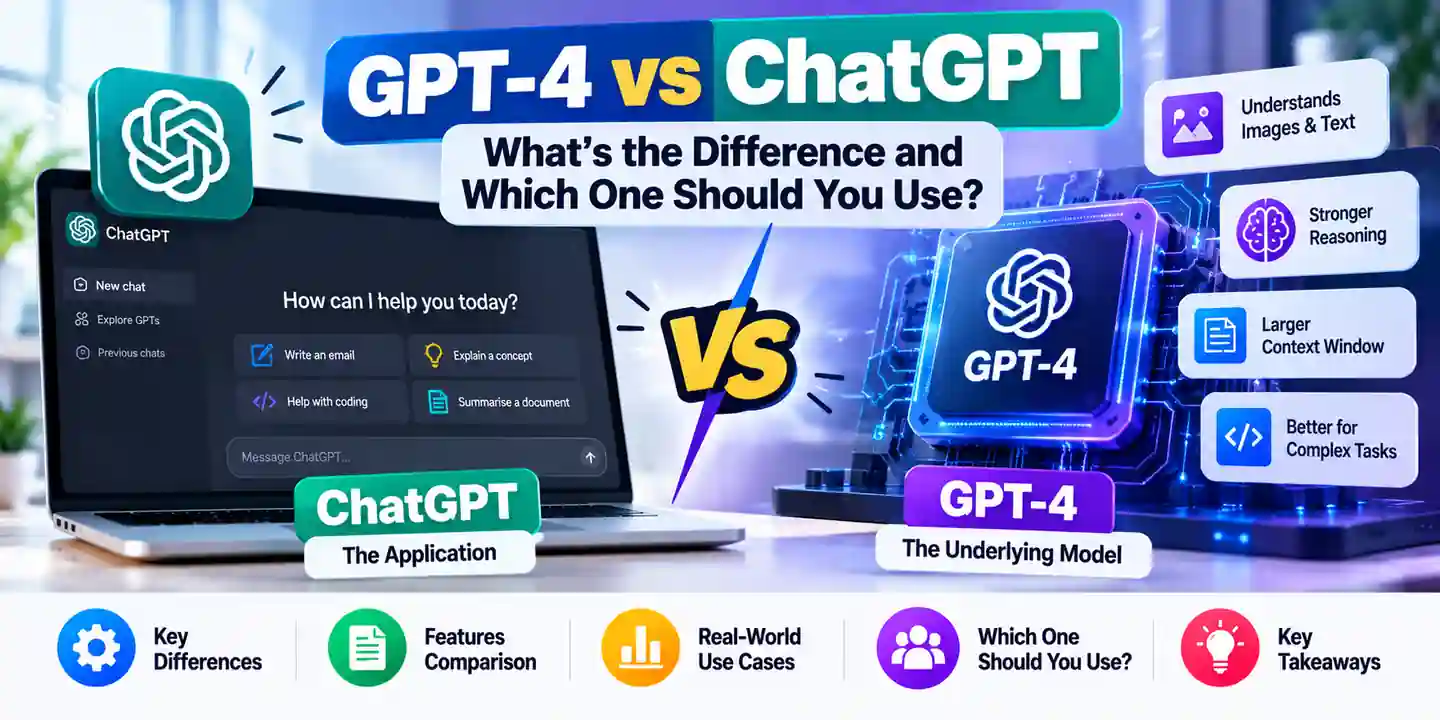
Quick answer: ChatGPT is the product; GPT-4 is the model. ChatGPT free users run on GPT-3.5 by default. GPT-4 is available through ChatGPT Plus (subscription) or directly via the OpenAI API.
What Is ChatGPT?
ChatGPT is a conversational AI assistant developed by OpenAI and released publicly in November 2022. It is an application — a chat interface — built on top of OpenAI's GPT series of language models. Users interact with it through a browser or mobile app at chat.openai.com, asking questions, requesting content, debugging code, or working through problems in natural language.
On the free tier, ChatGPT runs on GPT-3.5, a capable but older model. ChatGPT Plus subscribers (currently priced at $20/month) get access to GPT-4 within the same interface, along with other features such as plugins and advanced data analysis. So when someone says "I use ChatGPT," they could be using two very different underlying models depending on their subscription level.
Think of ChatGPT as the car and GPT-4 as the engine. You can have the car without the most powerful engine, and the engine exists independently of any single vehicle.
What Is GPT-4?
GPT-4 is a large multimodal language model released by OpenAI in March 2023. It represents a substantial architectural step forward from GPT-3.5 — the model that underpins the free version of ChatGPT. GPT-4 was trained on a broader dataset, uses a larger context window, and demonstrates markedly higher performance on standardised benchmarks for reasoning, coding, and knowledge recall.
Critically, GPT-4 is multimodal: it can process and respond to both text and images. A user can upload a photograph, a chart, or a diagram and ask GPT-4 to interpret, analyse, or act on it. This capability does not exist in GPT-3.5.
GPT-4 is accessible in three main ways:
- Through ChatGPT Plus (the $20/month ChatGPT subscription)
- Through the OpenAI API, where developers can integrate GPT-4 into their own products
- Through Microsoft Copilot, which uses GPT-4 under the hood
GPT-4 vs ChatGPT: At a Glance
FeatureChatGPTGPT-4Model typeGPT-3.5 (base) or GPT-4 (Plus)GPT-4 (multimodal)Image understandingNot available on GPT-3.5Yes — analyses images and text togetherContext windowUp to 4,096 tokens (GPT-3.5)Up to 128,000 tokensReasoning accuracyStrong for everyday tasksMarkedly higher on complex problemsMultilingual supportGoodExcellent, with improved fluencyAPI accessChatGPT API (GPT-3.5)GPT-4 API (separate pricing tier)Primary access pointchat.openai.com (free tier)ChatGPT Plus / OpenAI APIBest suited forGeneral Q&A, everyday writing tasksCoding, analysis, research, professional use
Key Differences Explained
1. The Product vs the Model
The most fundamental distinction is that ChatGPT is an application and GPT-4 is a model. OpenAI has built ChatGPT as a consumer product with a polished interface, conversation history, and a growing ecosystem of plugins and integrations. GPT-4 is the technical component — the neural network — that can be plugged into many different applications, ChatGPT being one of them.
2. Reasoning and Accuracy
On OpenAI's own benchmarks, GPT-4 substantially outperforms GPT-3.5 across domains including law, medicine, and mathematics. In bar exam simulations, GPT-4 scored around the 90th percentile; GPT-3.5 scored around the 10th. This gap matters most for tasks that require multi-step reasoning, nuanced interpretation, or domain-specific accuracy — not for straightforward writing or summarisation tasks where GPT-3.5 performs adequately.
3. Context Window
GPT-3.5 supports a context window of up to approximately 4,096 tokens — roughly 3,000 words. GPT-4 extends this to 8,192 tokens in its standard version, and up to 128,000 tokens in its extended context variant (GPT-4 Turbo). In practice, this means GPT-4 can read and respond to far longer documents without losing the thread of earlier content — a significant advantage for research, contract review, or any task involving extended text.
4. Image Understanding
GPT-4 is multimodal. You can share an image and ask it to describe, interpret, or act on what it sees. This opens up use cases such as analysing charts, reading handwritten notes, or walking through a user interface screenshot for debugging purposes. GPT-3.5 is text-only.
5. API Access and Developer Use
If you are building a product or integrating AI into a workflow, you interact with GPT-4 through the OpenAI API directly — not through the ChatGPT interface. GPT-4 via the API carries a per-token pricing model that differs from the ChatGPT Plus flat subscription. Developers who need fine-grained control over model behaviour, system prompts, or output structure typically work with the API directly rather than through any consumer product.
6. Cost
ChatGPT free (GPT-3.5): no cost. ChatGPT Plus (GPT-4 access): $20/month. GPT-4 via API: approximately $0.03 per 1,000 input tokens and $0.06 per 1,000 output tokens for gpt-4, with different rates for GPT-4 Turbo. The exact pricing is published on OpenAI's pricing page and subject to change.
Note: Pricing figures are as of the time of writing. Always verify current rates at platform.openai.com/pricing before building a cost model for a project.
Which Should You Use? A Practical Guide
The right choice depends on your task, your technical context, and your budget.
Use ChatGPT (free / GPT-3.5) if:
- You need a quick, capable assistant for everyday writing, summarisation, or Q&A
- You are exploring AI for the first time and want a low-commitment starting point
- Your tasks do not require complex multi-step reasoning or long document analysis
- You do not need image understanding
Use ChatGPT Plus (GPT-4) if:
- You regularly work on tasks requiring higher accuracy — drafting contracts, analysing reports, complex coding
- You want to share images or visual content with the model
- You need access to GPT-4 without writing code or managing an API
- You want OpenAI's plugin ecosystem and advanced data analysis tools
Use the GPT-4 API directly if:
- You are building a product or automating a workflow
- You need control over the system prompt, response format, or model parameters
- You are processing large volumes of content programmatically
- You want to integrate GPT-4 into your own interface or application
Limitations to Be Aware Of
Neither ChatGPT nor GPT-4 is infallible. Both share the fundamental limitations of large language models:
- Knowledge cutoff: Both have a training data cutoff date. Neither has real-time internet access by default, though ChatGPT Plus has a browsing plugin that can perform live web searches.
- Hallucination: Both models can generate plausible-sounding but incorrect information. This is less frequent in GPT-4 but remains a known behaviour. Always verify factual claims in high-stakes contexts.
- No persistent memory (by default): Each conversation starts fresh unless the user manually saves context or uses a memory feature (currently in limited rollout).
- Context window limits: Even GPT-4's 128,000-token extended context has limits. Very large codebases or document sets may still exceed what a single prompt can handle.
- Cost at scale: For high-volume API usage, GPT-4's per-token pricing can accumulate quickly. GPT-3.5 remains the more cost-efficient option for large-scale, lower-stakes applications.
How These Models Have Evolved
OpenAI has continued to iterate since GPT-4's launch. GPT-4 Turbo introduced a significantly extended context window and reduced pricing compared to the original GPT-4 API. OpenAI has also released GPT-4o ("omni"), which integrates text, image, and audio modalities into a single model with faster response times.
The ChatGPT product itself has evolved in parallel, adding voice conversation, memory features, custom GPTs, and enterprise controls. This means the distinction between "ChatGPT" and "GPT-4" is itself a moving target — the product continues to bundle new capabilities that go beyond the underlying language model.
For professionals making decisions about AI integration, following OpenAI's model release notes and pricing updates directly is more reliable than relying on any single summary, including this one.
Frequently Asked Questions
Is ChatGPT the same as GPT-4?
No. ChatGPT is an application developed by OpenAI. GPT-4 is an AI model. The free version of ChatGPT uses GPT-3.5. To access GPT-4 through ChatGPT, you need a ChatGPT Plus subscription.
Can I use GPT-4 for free?
GPT-4 access through ChatGPT requires a Plus subscription ($20/month). However, Microsoft Copilot (formerly Bing Chat) has offered GPT-4 access at no cost in certain configurations. Access and pricing policies change frequently — verify current options at openai.com.
Is GPT-4 better than ChatGPT?
GPT-4 and ChatGPT are not directly comparable in that way — one is a model and the other is an application. GPT-4 is a more capable model than GPT-3.5, which is what ChatGPT's free tier uses. So if the comparison is GPT-4 vs GPT-3.5, GPT-4 performs better on complex tasks, reasoning, and image understanding.
What is GPT-4o?
GPT-4o (pronounced "GPT-four-oh") is a multimodal model released by OpenAI in 2024 that processes text, images, and audio natively within a single architecture. It is faster and more cost-efficient than the original GPT-4, and has been made available to both free and Plus ChatGPT users.
Which is better for coding — GPT-4 or ChatGPT?
For complex programming tasks, GPT-4 (whether accessed through ChatGPT Plus or the API) significantly outperforms GPT-3.5. GPT-4 handles longer codebases, catches subtle logic errors, and provides more accurate debugging explanations. For simple scripts or quick code snippets, GPT-3.5 via the free ChatGPT interface is often sufficient.
Can GPT-4 access the internet?
By default, GPT-4 does not browse the internet. Its knowledge is limited to its training data cutoff. ChatGPT Plus users can enable a browsing tool that retrieves live web content, but this is a plugin — not a core model capability.
How do I access GPT-4 through the API?
Sign up for an OpenAI account at platform.openai.com, generate an API key, and specify "gpt-4" or "gpt-4-turbo" as your model parameter when making API calls. API usage is billed per token, with separate rates for input and output tokens.
Conclusion
The confusion between GPT-4 and ChatGPT is understandable, but the distinction has real practical implications. ChatGPT is where most people first encounter AI conversation; GPT-4 is the model architecture that powers its most capable version. For everyday tasks, the free ChatGPT tier (GPT-3.5) is a functional and accessible starting point. For professional use, research, coding, or any task where accuracy and reasoning depth matter, GPT-4 is the appropriate choice.
As the field develops rapidly, the most important habit is to stay current: OpenAI's model and pricing pages are updated regularly and provide authoritative information on what each tier offers at any given point.
Get a free marketing audit
See exactly where your SEO, ads and website are leaving money on the table.